Wave Money
Taking mobile money to one of the world's most unbanked countries — and evolving a simple P2P service into a SuperApp serving consumers and businesses nationwide.
The challenge
Myanmar in the mid-2010s was one of the least banked countries on earth — the overwhelming majority of adults had no account of any kind, and cash moved the way it had for generations: by hand, by bus, by trusted courier. When the country's telecoms market opened up, the opportunity to leapfrog straight to mobile money was enormous — but so was the challenge.
Everything had to be built from nothing: the regulatory framework was brand new, the agent network didn't exist, smartphone penetration was exploding but financial literacy was low, and customer trust had to be earned one transaction at a time — in a market where people had good historical reasons to keep their money in cash.
Scope — was this real?
The need was undeniable — millions of internal migrant workers sending money home from Yangon and Mandalay to villages with no bank branch for miles. The question was whether a formal product could beat the informal networks people already trusted. That meant getting the basics brutally right: price competitive with informal channels, cash-in and cash-out within walking distance, and a service simple enough to use on a first-ever smartphone.
Shape — the product and the rails
Wave Money was built as a joint venture bringing together a telco's distribution reach and a bank's regulatory standing — licensed under Myanmar's new mobile financial services regulation. The product was shaped around the agent: tens of thousands of corner shops became the branch network, handling cash-in and cash-out for customers who lived entirely in cash.
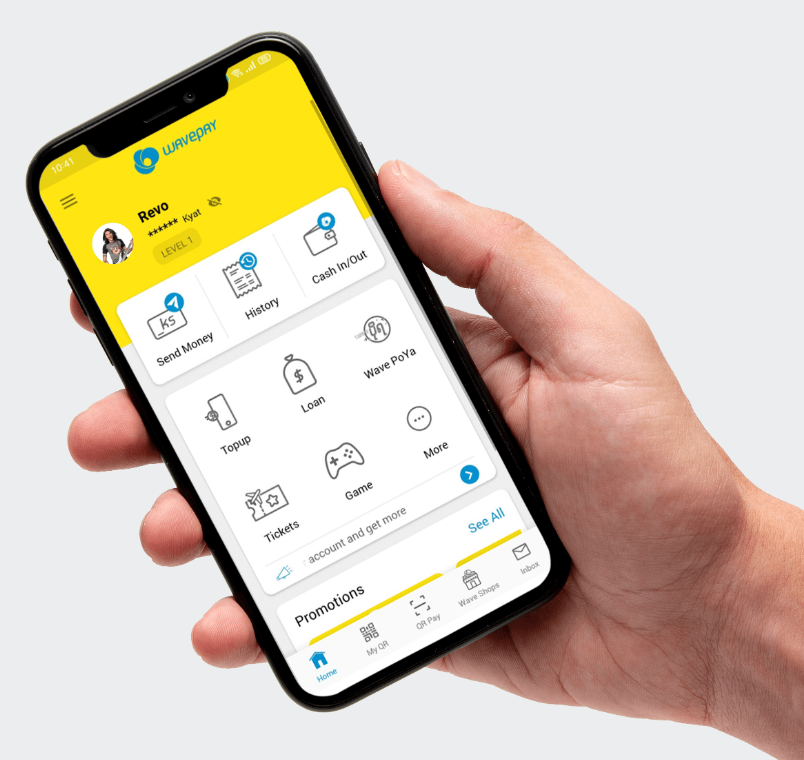
The digital experience — WavePay — was designed to grow with the customer: start with over-the-counter transfers through an agent, graduate to a wallet, then to payments, top-ups and everyday financial life.
Solve — build, ship, grow
The work was relentless product iteration in a market that had never seen anything like it. Onboarding had to work for first-time smartphone users. The agent experience mattered as much as the customer's — the agent-facing tools were a product in their own right, and an agent who couldn't complete a transaction was a customer lost to the informal network for good.
As the fundamentals proved out, the growth compounded — including a period where active users grew from 40,000 to 240,000 in four months as product, pricing and distribution finally clicked together.
Scale — from P2P to SuperApp
With the remittance core proven, WavePay evolved into a genuine SuperApp — payments, top-ups, bill payment and business services layered onto the wallet for both consumers and B2B customers. Each addition rode the trust and distribution the P2P product had already earned.
Wave Money went on to become Myanmar's dominant mobile financial services provider — the rails a meaningful share of the country now runs on.
From zero to national scale
1m+
wallet customers served
40k → 240k
active user growth in four months
0 → 1
built from a blank page in a brand-new regulatory framework
SuperApp
evolved from simple P2P to full consumer and B2B services
Building something like this?
Mobile money, product, agent networks, 0-to-1 in hard markets — this is the work I do. Tell me what you're facing and I'll tell you honestly whether I can help.